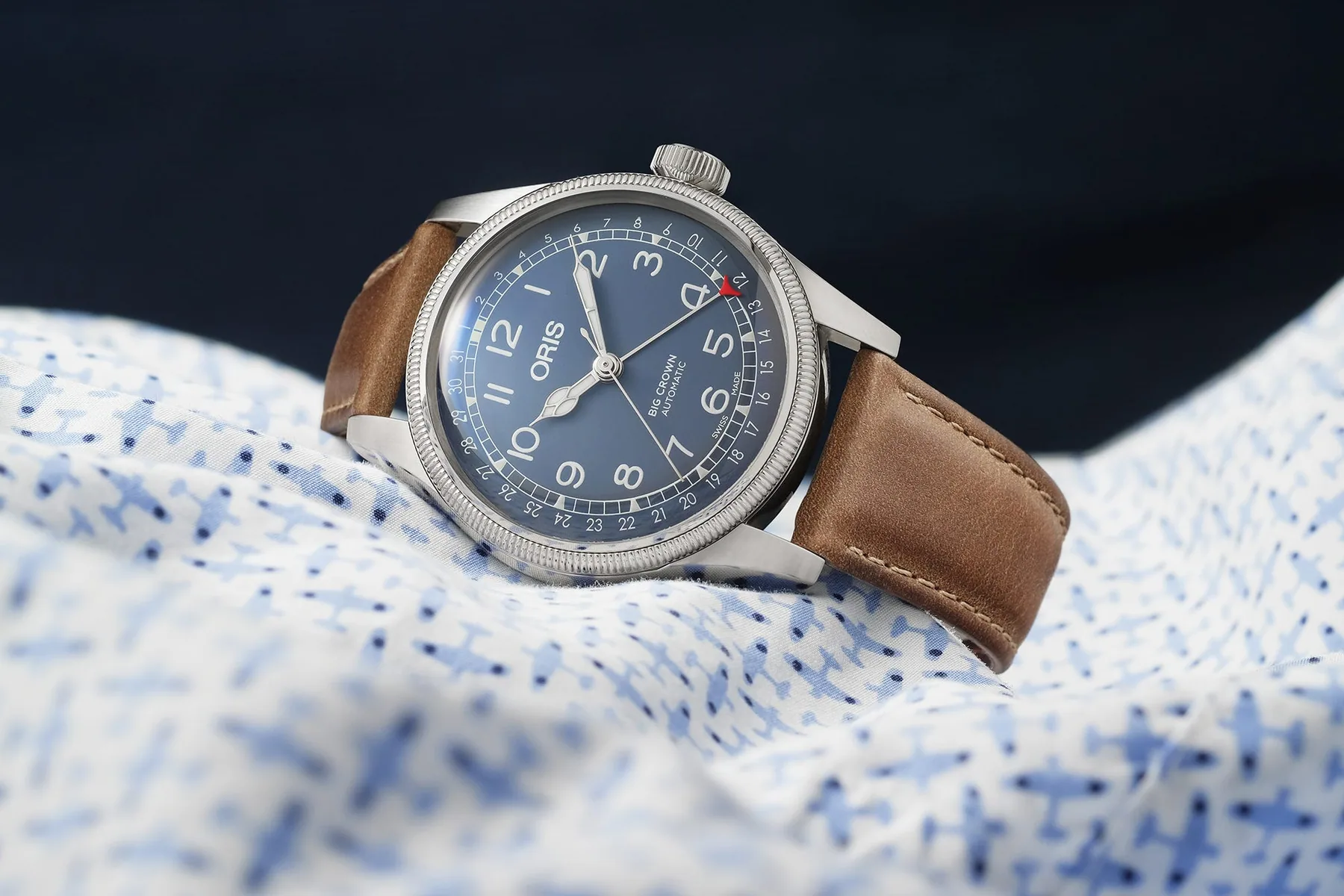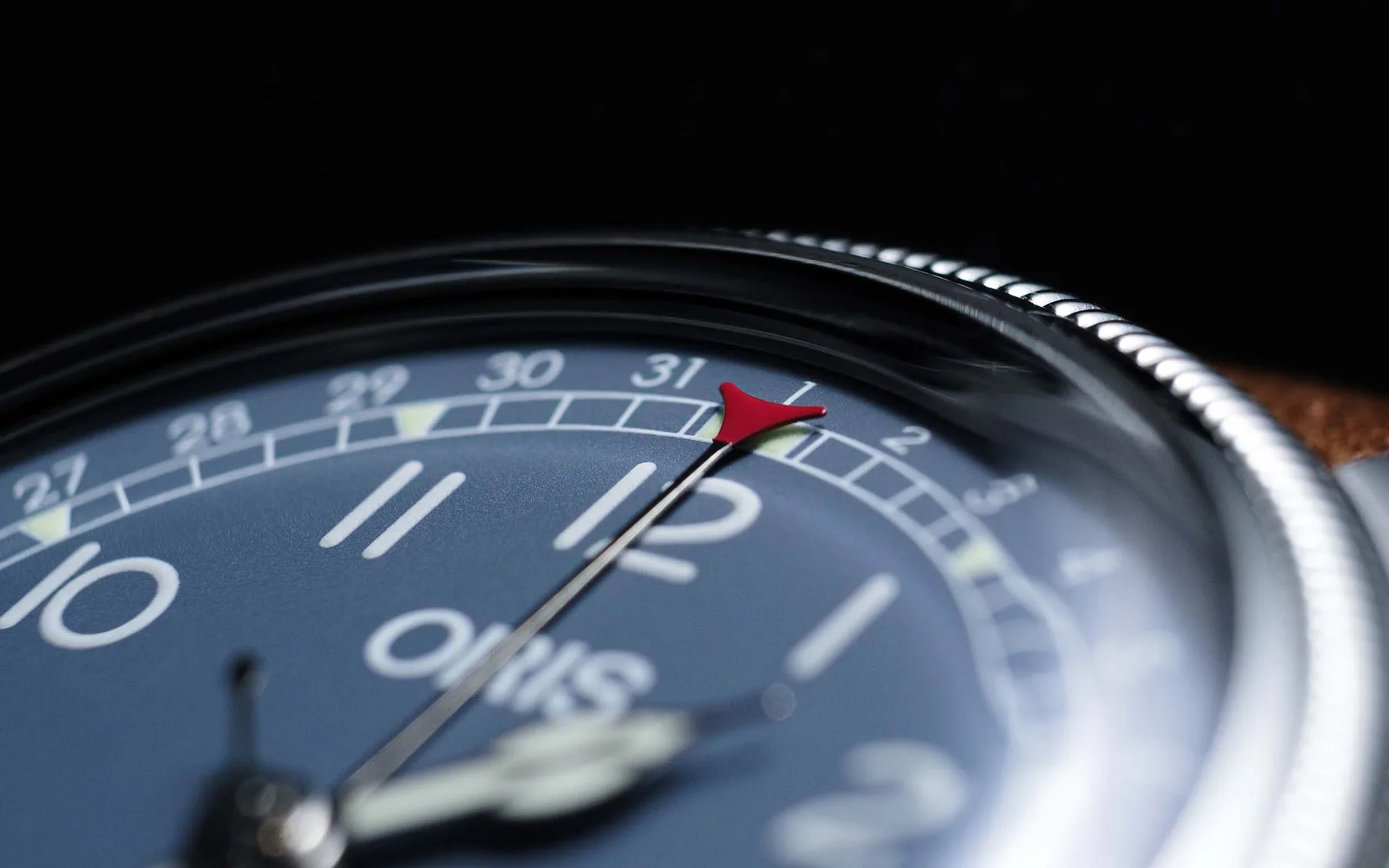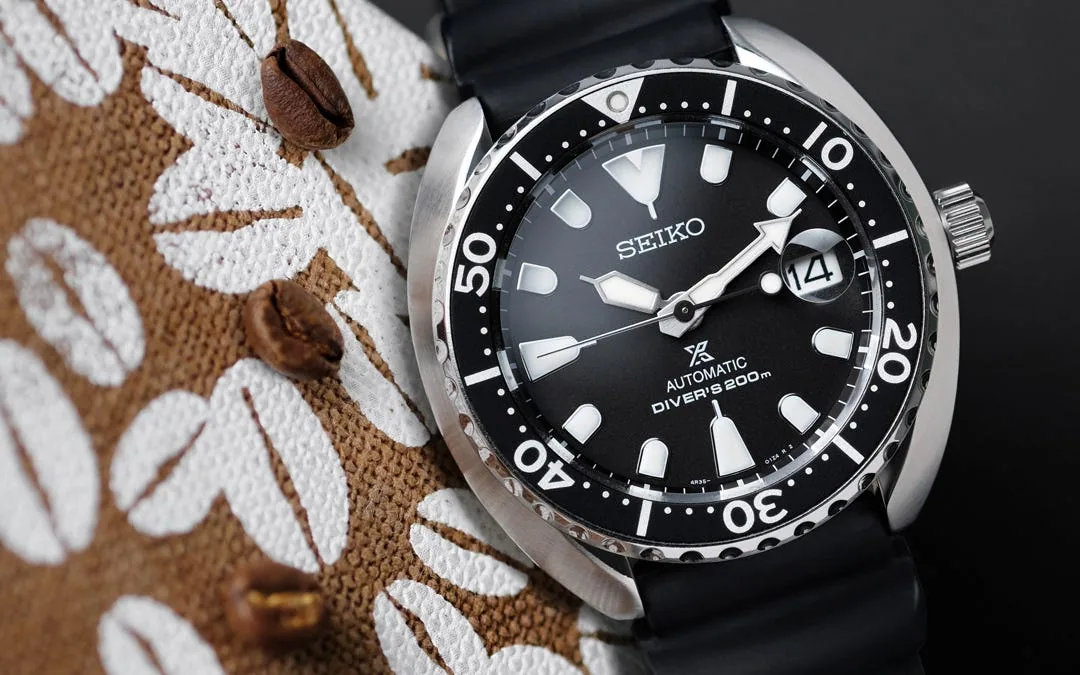
One of the things that I enjoy about the watch community is that I end up meeting very interesting people, with passions that go way beyond watches, usually being activities that require research and attention to detail: photography, history, cars, and of course, coffee — #watchesandcoffee is a popular Instagram hashtag, and the group Drinking Coffee and Talking Watches created by during the quarantine quickly expanded to 4000 members over the course of a few weeks, and even TAG Heuer recently released a watch with an actual coffee dial!
I started my watch journey two years ago, around the same time as I started reading and learning about specialty coffee. The book The World Atlas of Coffee by James Hoffman provided a great starting point, and while I’m by no means a coffee expert, it’s something I truly enjoy and appreciate on a daily basis.
“Don’t invest in an espresso machine at home unless you want a new hobby.”
- James Hoffmann, in The World Atlas of Coffee
With that in mind, I decided to write a small article about the many possible ways of making coffee at home and explore the connection between the world of coffee making, your personality and watch choices. It might be a long stretch, but I hope it’s a fun one. So sit down, grab a cup of coffee and let’s get started.
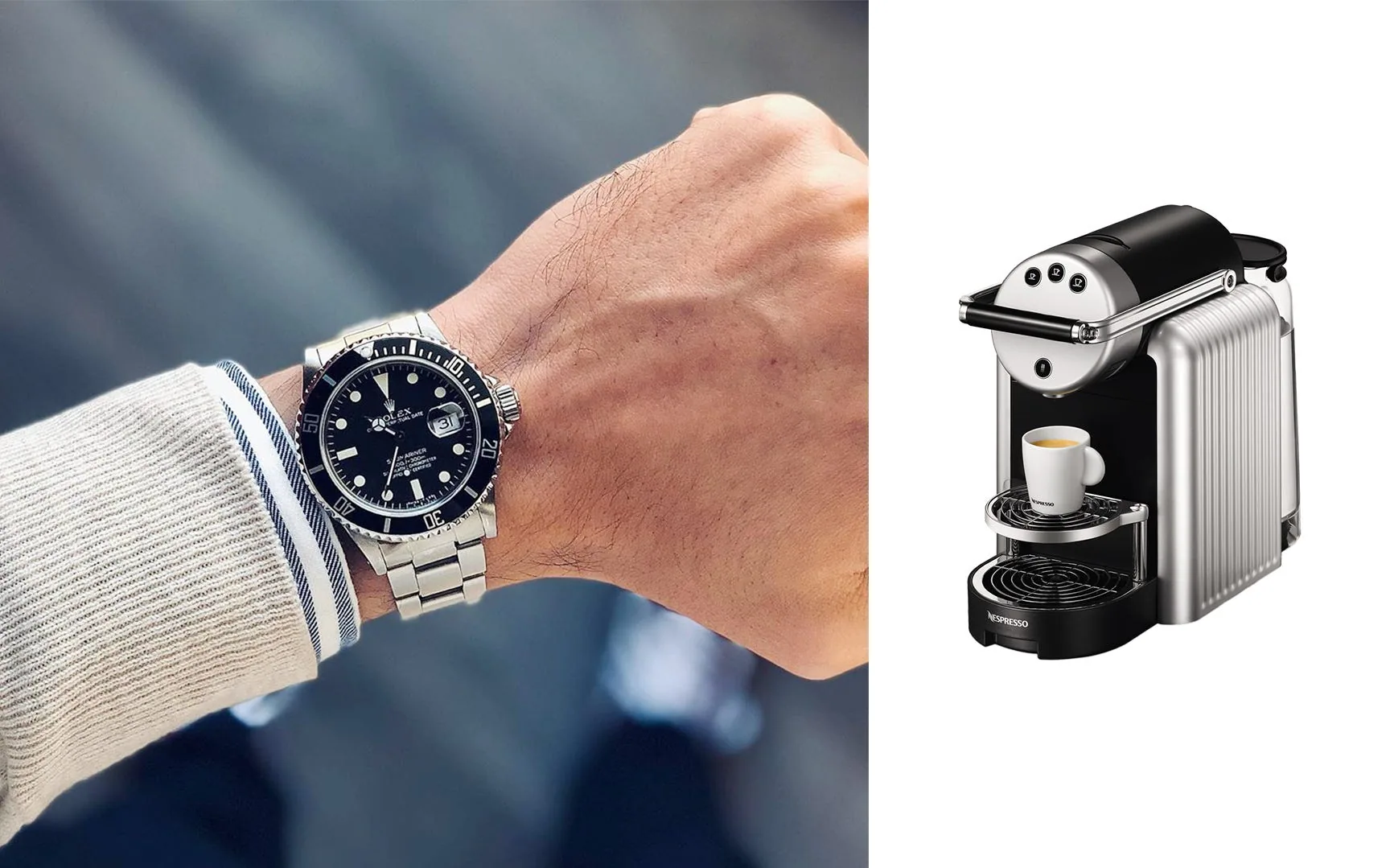
Nespresso — Rolex Submariner
Nespresso was introduced in the 90s and quickly gained popularity due to its consistency, ease of use, and wide range of flavours. It is seen by the consumers as a premium type of coffee, it’s endorsed by celebrities and can be purchased in their boutiques in a way that resembles the experience of buying a luxury watch (complimentary coffee included). Also, did you know that the Nespresso coffees are roasted, ground and encapsulated in Switzerland?
If you start the day by popping a Nespresso capsule, you probably appreciate the simple things in life and tend to choose the tools that get the job done. After all, coffee is coffee, caffeine is caffeine, right?
The Rolex Submariner might not be the fanciest watch around, but it’s a solid and well proven dive watch that can be used on a daily basis for years without frills or maintenance. You can also match your favorite Nespresso flavour with the bezel color on the Rolex — The black bezel model shown on the photo deserves to be paired with a shot of Ristretto, of course!
See also: Tudor Black Bay 58
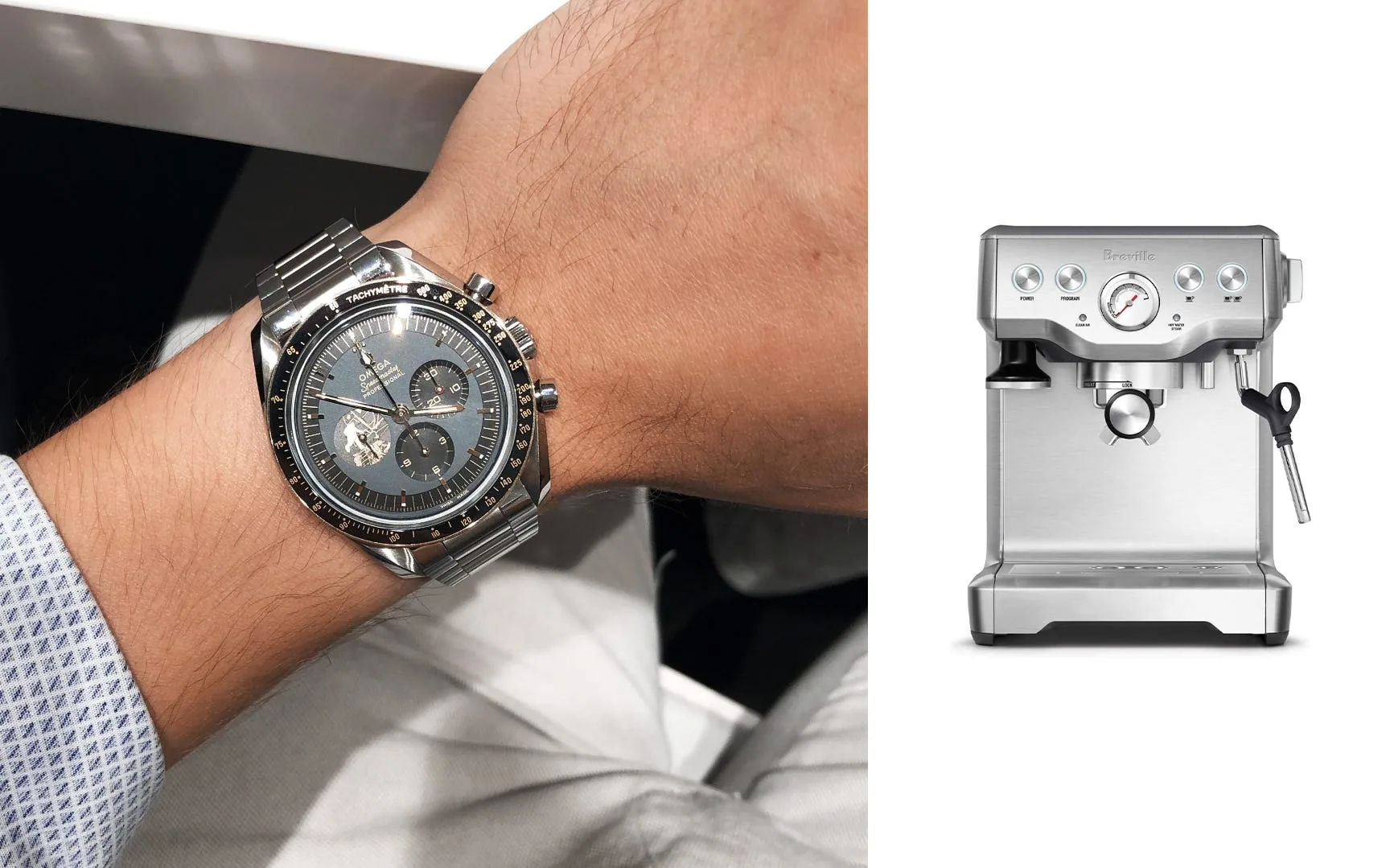
Manual Espresso Machine — Omega Speedmaster
Before even getting into watches, your passion for engineering always attracted you to the beauty of complex things, the mechanics and circuits that make the world work.
During a trip to Italy, you fell in love with their short and syrupy espresso, and you have been chasing the perfect way to recreate that crema at home. After lots of research, you invested in a lever espresso machine, went down the deep rabbit hole of dialing-in the espresso grind and how to make the perfect latte art. Your machine takes ages to clean and it’s more complex to repair than the lunar module, but for you that’s all part of the fun.
The same principles can be applied to your watch choice — to satisfy your need for controls and mechanical complexity, the obvious decision is the Omega Speedmaster (a.k.a. The Moonwatch). It’s the modern iteration of the classic design worn by astronauts on their lunar missions, with a three register chronograph dial, two pushers next to the crown to activate it and it’s powered by a manually wound movement. You enjoy the daily ritual of handwinding the watch, and the chronograph function makes it the perfect tool to time your 30 second espresso brew.
See also: Breitling Navitimer
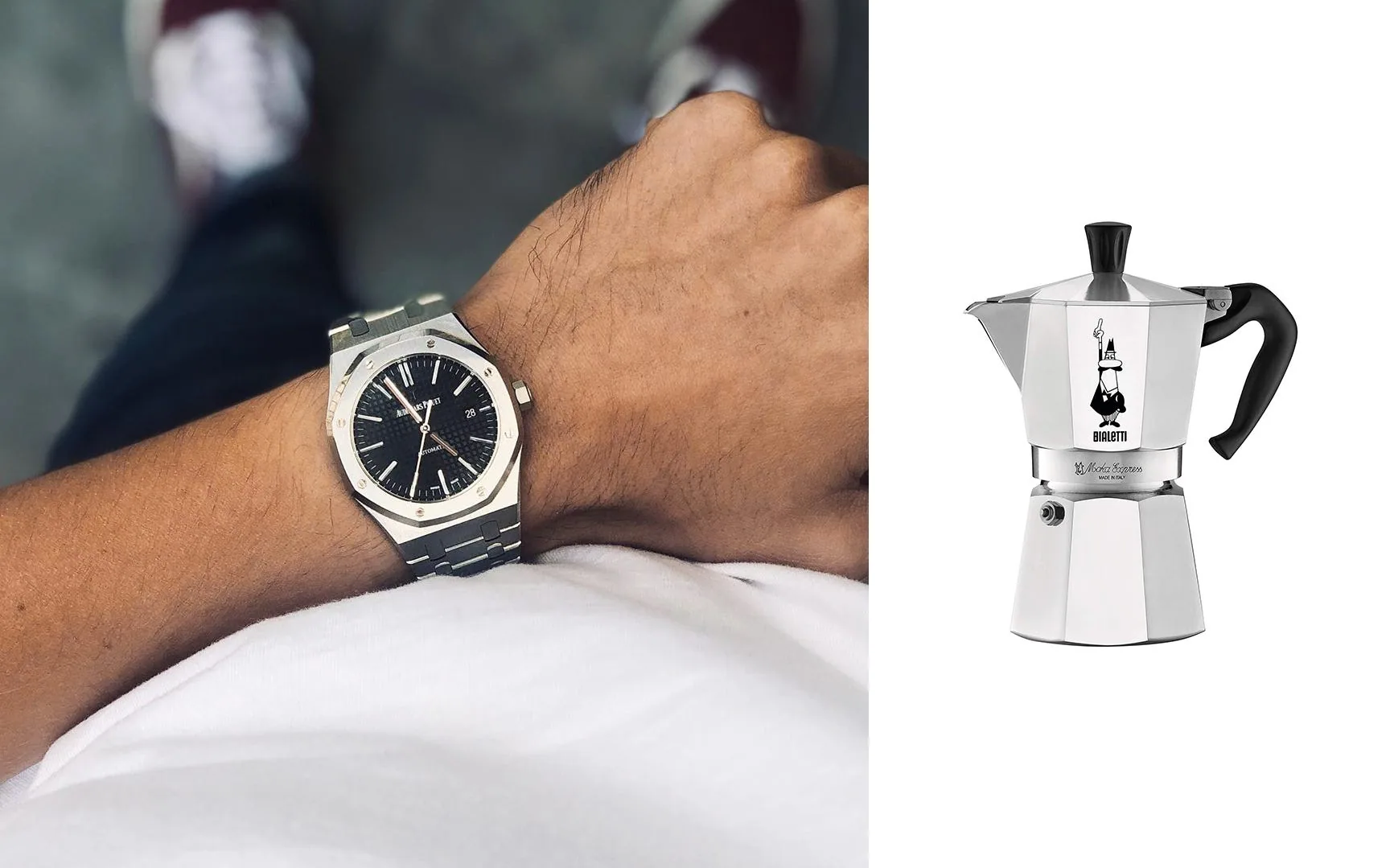
Moka Pot — Audemars Piguet Royal Oak
One of the items you can find in any Italian household is the Moka Pot — a stovetop coffee machine and one of the most iconic kitchen appliances ever created. Invented in 1933, the Bialetti boasted a futuristic and clever design, with its aluminum octagonal shape, quickly becoming a symbol of Italian design — you can even find an exemplar in the Museum of Modern Art .
A parallel breakthrough in watch design came in the 1970s, when creative minds such as Gerald Genta introduced the concept of integrated design (where the bracelet and case blend seamlessly), and the Audemars Piguet Royal Oak is the perfect example of that design philosophy. Similarly to the Bialetti, it’s an industrial design with sharp edges and an octogonal bezel that gives it a futuristic and refined look.
One of the disadvantages of the Bialetti is that if you leave it in the stove for too long, the coffee can burn and end up tasting bitter. The same applies to the Royal Oak, as the price raises and infinitely long wait lists can also lead to a bitter taste in your mouth!
See also: Bulgari Octo Finissimo
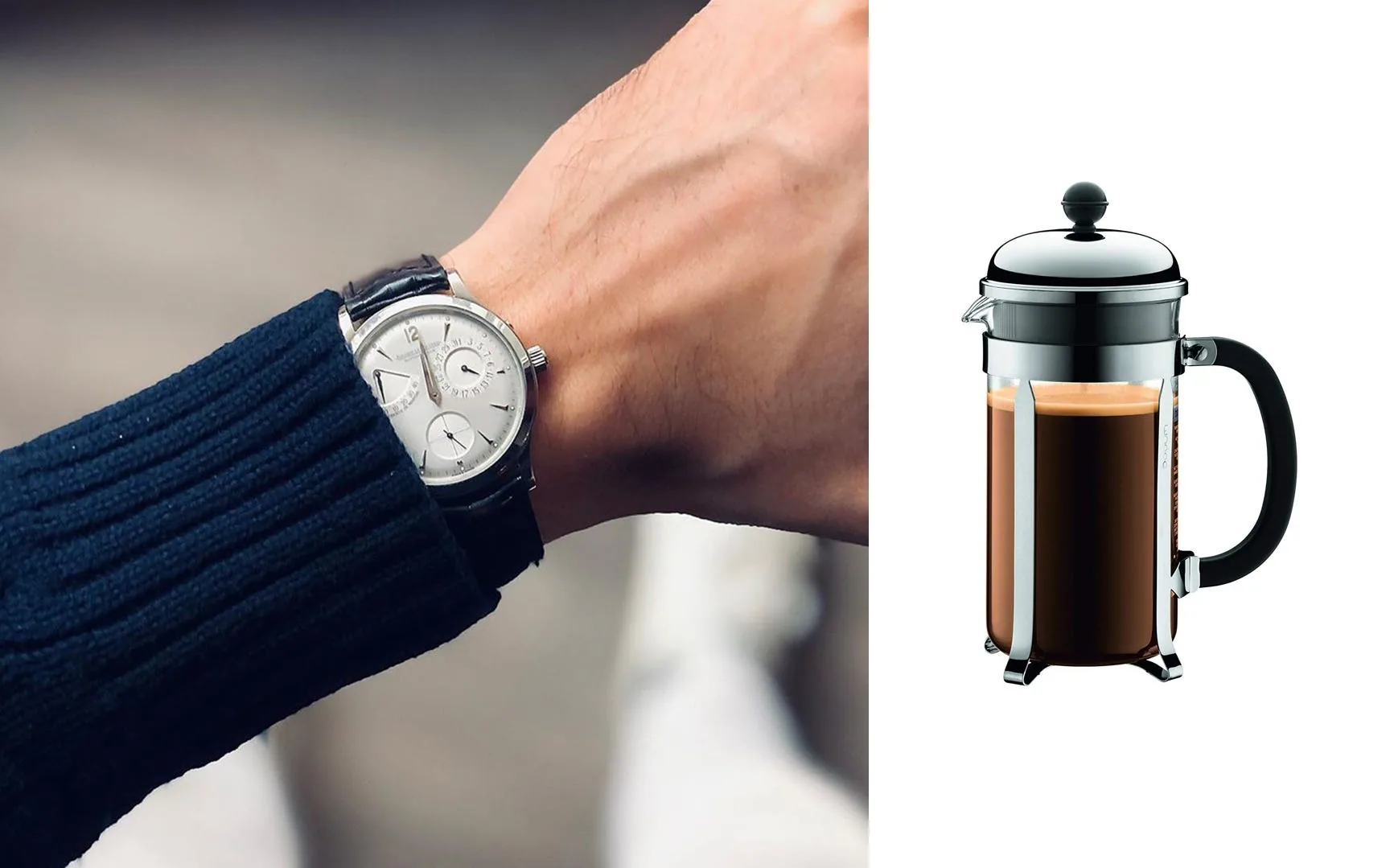
French Press — JLC Réserve de Marche
The French Press is an immersion based method for brewing coffee. This means that in order to make a coffee you have to add the ground beans and hot water to the glass container, and wait. This method is very user friendly (as long as you have enough patience to let the coffee sit before serving it) and it leads to a rich brew with even extraction. This no-fuss process is the best choice for those who prefer relaxing over a cup of coffee rather than from making it. For a french press lover, latte art or experimental coffee techniques are seen purely as a waste of time, that could be better spent reading or appreciating what’s on the wrist — the Jaeger-LeCoultre Réserve de Marche.
This early 2000s model features a 37mm case and an asymmetrical dial that displays the power reserve, date and small seconds. After further consideration, what seems to be a visual mess ends up looking like a very balanced and dynamic dial layout. As a bonus, if you flip the watch over you can also spend countless hours admiring the movement made in-house by JLC and subject to 1000 hours of factory testing.
During the time you spent admiring the watch and trying to pronounce “Jaeger” correctly, the coffee got cold. Well, there’s always time to make another one!
See also: Cartier Tank
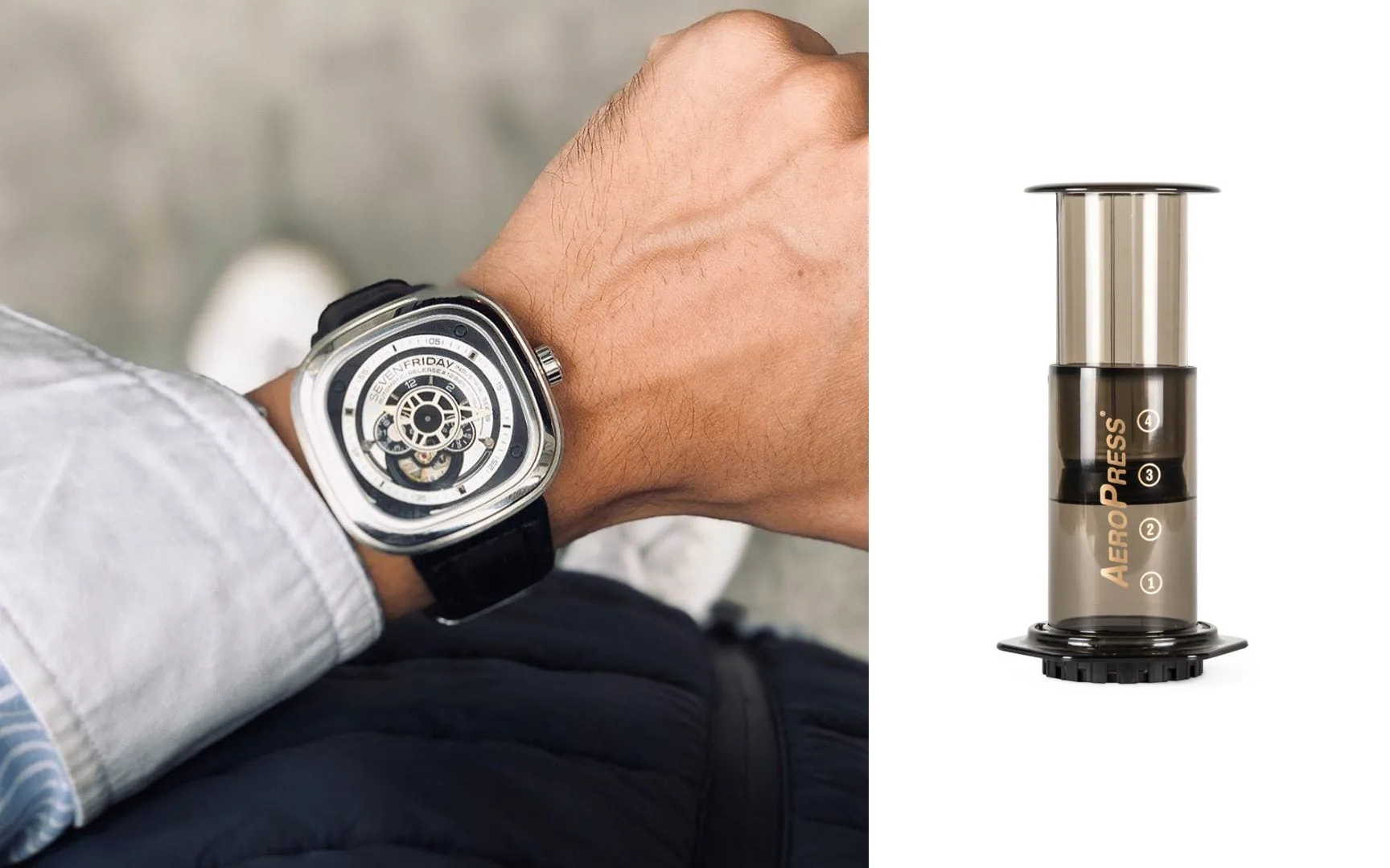
AeroPress — Sevenfriday P1B/01
AeroPress. Sounds futuristic and it looks nothing like the coffee makers you normally see on the streets. In fact, this device was invented by a company that specializes in toys and sporting goods (ever heard of the Aerobie?), and despite looking like a giant plastic syringe, it does make great coffee!
The AeroPress is the perfect choice for creative minds and for those who aren’t afraid of experimenting — there are countless recipes available for this brewer, and it even features its own international championship ! It’s an affordable way of getting into the hobby, and my recommendation for those just starting in the world of coffee.
To match with this hip, funky and different coffee maker, the first watch brand that came to mind was SevenFriday — an experiential brand that seems to have carved their own niche with unique looking timepieces for affordable prices. It seems like there is a lot of hate online for these watches, and while I don’t see myself wearing one, I think it’s a brand with a unique style and no bullsh*t — something you seldom see these days.
On a more personal note, my current favorite way of making coffee at home is with the AeroPress, and while I don’t own a SevenFriday, my first mechanical watch from Junkers had a Japanese Miyota movement like most of SevenFirday watches offer!
See also: Casio G-Shock
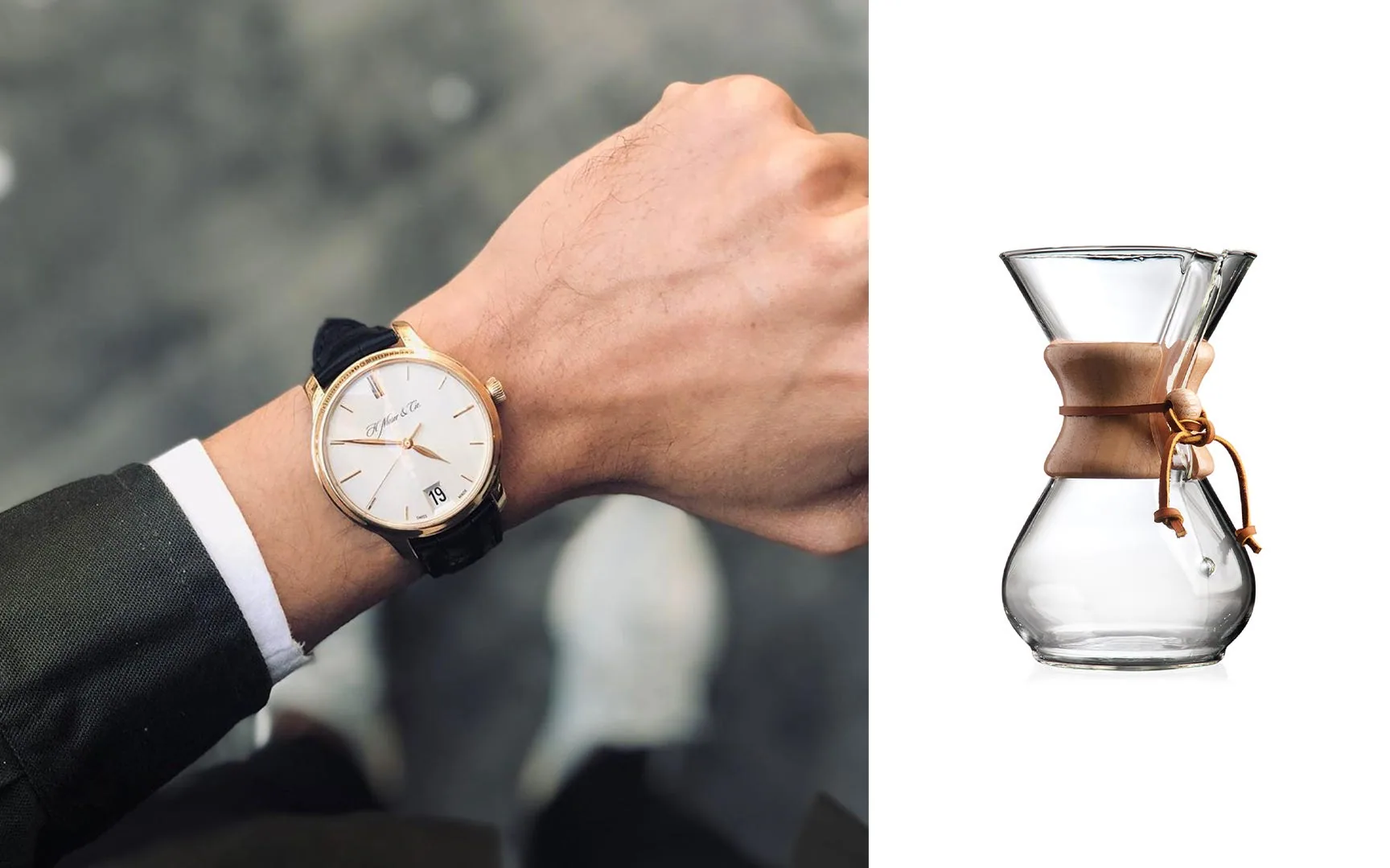
Pour Over — H. Moser Endeavour Big Date
Pour over coffee basically consists in pouring hot water through coffee grounds in a filter into a carafe or mug. And while it looks like a simple process, its technique is one of the most difficult to master and as such it experienced a rise in popularity among the specialty coffee community.
There are several coffee makers for pour over, but my favorite is the Chemex. It has an hourglass shaped body made from a single piece of heat resistant glass and a wooden collar around the neck, which allows it to be easily handled and poured when full of hot coffee. This collar adds a splash of color to the Chemex and makes it look like a perfect blend of laboratory precision and organic nature. It’s considered a design icon (with the original model from 1941 being featured next to the Bialetti in the Museum of Modern Design), and it became part of pop culture thanks to shows like Mad Men, Friends and even James Bond!
The H. Moser Endeavour Big Date perfectly translates the concepts I just described to the world of watches. It looks simple and minimalist, but a closer look reveals the organic concave curves of the gold case, the way it sits on the wrist, and the perfectly balanced dial with a center big date at 6 o’clock. Flipping the watch over, you can find a proprietary movement full of modern technologies, like the Straumann Hairspring® with stabilised Breguet overcoil (Google it!), an interchangeable escapement module and a 7 day power reserve with indicator visible through the sapphire caseback — a powerful caliber and a true paradise for watch geeks.
See also: Nomos Orion
I hope you enjoyed this crossover article and it was a good introduction to the world of coffee making at home. Perhaps it even gave you an idea for a new hobby during this quarantine period!
What Your Coffee Maker Says About Your Watch Choices was originally published in Watching Watches on Medium, where people are continuing the conversation by highlighting and responding to this story.
Bruno Candeias is a photographer and watch journalist based in Lisbon. He writes here whenever there is something worth writing.